
People with limb loss, children, accident survivors, athletes, and individuals in low-income regions benefit greatly from affordable and customizable prosthetics.
close
v
i
s
p
a
l
a
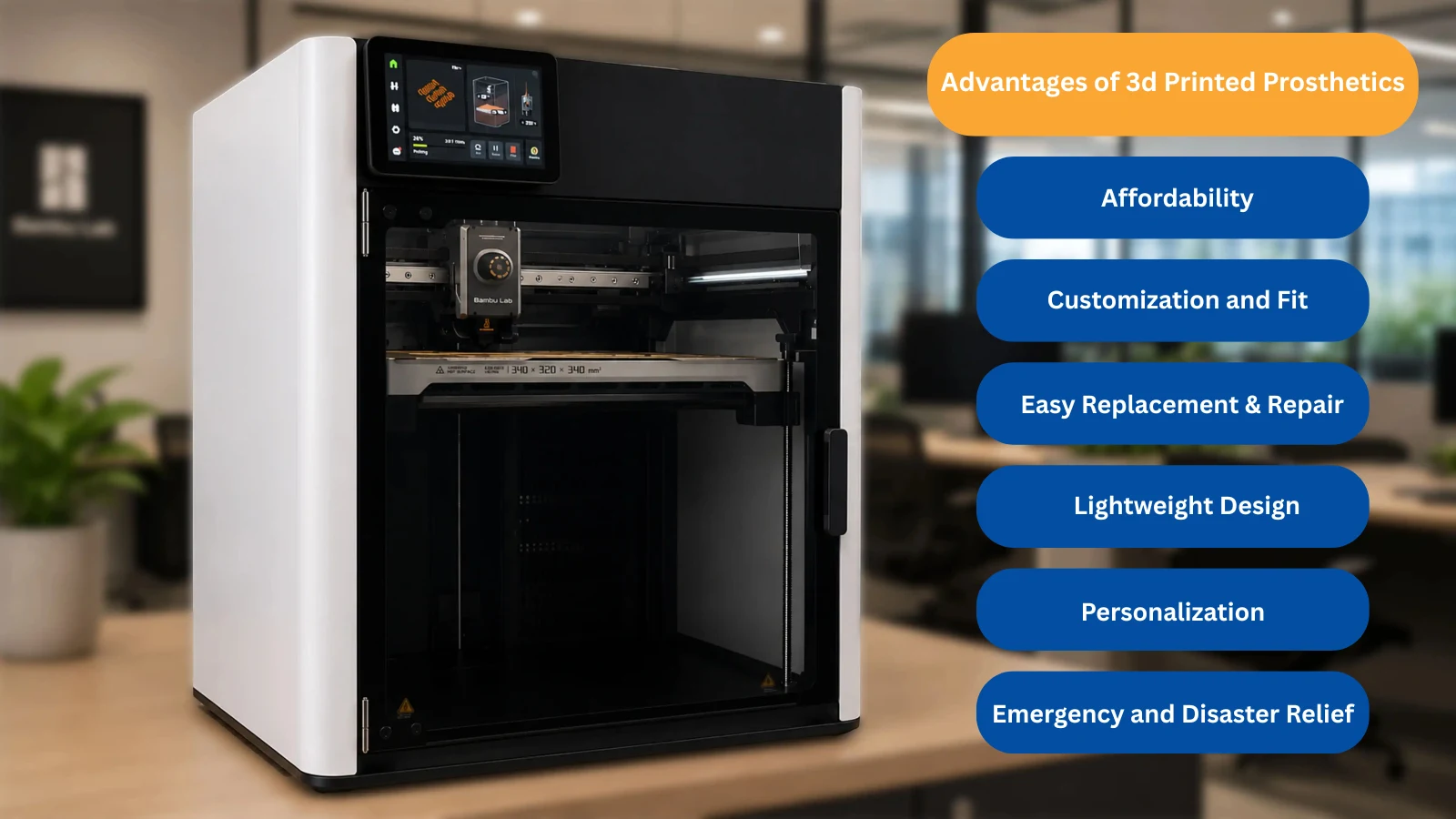
Advantages of 3D Printed Prosthetics
Introduction
The healthcare industry is changing rapidly with the help of advanced technology, and one of the most impactful innovations is 3D printed prosthetics. From affordable artificial limbs to highly customized designs, 3D prosthetic technology is transforming the lives of people with limb loss around the world. Traditional prosthetics are often expensive, heavy, and difficult to customize, while modern 3D printed solutions offer flexibility, comfort, and faster production.
Today, many organizations and every leading 3D printed prosthetics company are working to make prosthetic limbs accessible to more people, especially in developing countries. The rise of 3D printed prosthetics in India is also helping patients access better mobility solutions at lower costs.
In this article, we will explore the major advantages of 3D printed prosthetics, compare them with traditional prosthetics, discuss materials, use cases, future trends, and answer commonly asked questions.
What are 3D Printed Prosthetics?
3D printed prosthetics are artificial limbs created using additive manufacturing technology, commonly known as 3D printing. In this process, a digital model is used to print customized prosthetic parts layer by layer using specialized materials such as plastic polymers, carbon fiber composites, or flexible filaments.
A 3D printed prosthetic arm can be designed according to the exact measurements of a patient, making it more comfortable and functional than many traditional options.
These prosthetics are used for:
- Arms and hands
- Legs and feet
- Finger prosthetics
- Pediatric prosthetics
- Sports and activity-specific prosthetics
The growth of prosthetic innovation is making these devices more advanced, affordable, and widely available.
Benefits of 3D Printed Prosthetics
Affordability
One of the biggest advantages of 3D printed prosthetics is affordability. Traditional prosthetic limbs can cost thousands or even lakhs of rupees, making them inaccessible for many patients.
However, low-cost prosthetics made through 3D printing significantly reduce manufacturing and labor costs.
- Lower production expenses
- Reduced customization costs
- Faster manufacturing process
- Affordable replacement parts
This cost reduction is especially important for children who outgrow prosthetics quickly and require frequent replacements.
Customization and Fit
Every individual has different body measurements and movement requirements. Traditional prosthetics often require lengthy fitting sessions, but 3D prosthetic technology allows precise customization.
- Better comfort
- Improved mobility
- Reduced skin irritation
- Enhanced control and stability
Digital scanning and CAD software help create prosthetics that match the user’s anatomy perfectly.
Easy Replacement & Repair
Traditional prosthetic repairs can be expensive and time-consuming. In contrast, 3D printed parts can be recreated quickly using saved digital models.
- Faster repairs
- Lower maintenance costs
- Easy replacement of damaged components
- Quick reprinting of specific parts
This makes 3D printed prosthetics practical for daily use and long-term support.
Lightweight Design
Weight plays a major role in prosthetic comfort. Many traditional prosthetics use heavy materials, causing discomfort after long usage.
A 3D printed prosthetic arm is usually lighter because it uses optimized structures and lightweight materials.
Benefits of Lightweight Prosthetics:
- Less fatigue
- Easier movement
- Improved comfort
- Better usability for children and elderly users
Personalization
Modern users want prosthetics that reflect their personality and lifestyle. 3D printing allows unique designs, colors, and artistic customization.
- Favorite colors
- Superhero-themed prosthetics for children
- Stylish patterns and textures
- Sports-specific designs
This personalization helps users feel more confident and emotionally connected to their prosthetic devices.
Environmental Benefits
3D printing also contributes to sustainable manufacturing.
- Less material waste
- Efficient production
- Reduced transportation requirements
- Use of recyclable materials
Compared to traditional manufacturing methods, additive manufacturing uses only the required amount of material, reducing industrial waste.
Use Cases of 3D Printed Prosthetics
The applications of 3D printed prosthetics are expanding rapidly across healthcare sectors.
Pediatric Prosthetics
Children require frequent prosthetic replacements as they grow. 3D printing provides affordable and quick solutions.
Sports Prosthetics
Athletes use customized prosthetics designed for specific activities like cycling, running, and swimming.
Emergency and Disaster Relief
Low-cost prosthetics can be produced quickly for accident victims and war survivors.
Rural Healthcare Access
The rise of 3D printed prosthetics in India is helping patients in remote regions access affordable prosthetic care.
Upper Limb Prosthetics
Customized hands and arms improve grip strength and mobility for users.
Advantages of 3D Printed Prosthetics Over Traditional Prosthetics
There are several reasons why 3D prosthetic technology is gaining popularity over conventional prosthetic manufacturing methods.
|
Feature |
3D Printed Prosthetics |
Traditional Prosthetics |
|
Production Time |
Faster manufacturing, often completed within days |
Longer production time, may take weeks or months |
|
Customization |
Highly customizable based on patient measurements and needs |
Limited customization options |
|
Repair Cost |
Lower repair and maintenance cost |
Expensive repair process |
|
Weight |
Lightweight and comfortable for daily use |
Usually heavier due to traditional materials |
|
Replacement Process |
Easy and quick replacement using digital designs |
Replacement can be slow and costly |
|
Design Flexibility |
Greater flexibility in shapes, colors, and personalized designs |
Limited design flexibility |
|
Accessibility |
More affordable and accessible for developing nations |
Less accessible due to higher costs |
|
Manufacturing Process |
Uses advanced 3D prosthetic technology and digital modeling |
Uses conventional manual manufacturing methods |
|
User Comfort |
Better fit and comfort through precise customization |
May require multiple fittings for comfort |
Materials Used in 3D Printed Prosthetics and Their Benefits
Different materials are used depending on the purpose and durability requirements.
|
Material |
Benefits |
|
PLA (Polylactic Acid) |
Affordable and eco-friendly |
|
ABS Plastic |
Strong and durable |
|
TPU (Thermoplastic Polyurethane) |
Flexible and comfortable |
|
Nylon |
Lightweight and durable |
|
Carbon Fiber Composites |
High strength with low weight |
|
Resin Materials |
Smooth finish and precision |
These materials help improve functionality, comfort, and long-term usability.
Benefits of 3D Printed Prosthetics for Children
Children are among the biggest beneficiaries of 3D prosthetic technology.
Affordable Replacements
Children outgrow prosthetics quickly, and 3D printing makes replacements affordable.
Attractive Designs
Colorful and personalized designs increase confidence and emotional acceptance.
Lightweight Comfort
Lighter prosthetics reduce strain and improve movement.
Faster Production
Children can receive updated prosthetics within days instead of waiting months.
Future Trends of 3D Printed Prosthetics
The future of prosthetic innovation looks highly promising.
AI-Integrated Prosthetics
Artificial intelligence may improve movement prediction and control.
Smart Sensors
Future prosthetics could include touch-sensitive technology.
Advanced Biocompatible Materials
Researchers are developing stronger and more skin-friendly materials.
Robotic Prosthetics
Bionic limbs with advanced movement capabilities are becoming more accessible.
Expansion in Developing Countries
The growth of 3D printed prosthetics in India and other emerging economies will improve healthcare accessibility.
As technology evolves, prosthetics will become smarter, more affordable, and more functional.
Conclusion
3D printed prosthetics are revolutionizing the healthcare industry by making artificial limbs more affordable, customizable, lightweight, and accessible. From children needing regular replacements to adults seeking comfortable mobility solutions, 3D prosthetic technology offers practical benefits for a wide range of users.
The growing demand for low-cost prosthetics, combined with continuous prosthetic innovation, is shaping the future of rehabilitation and mobility care. As more companies invest in advanced manufacturing and healthcare technology, the future of 3D printed prosthetics in India and globally looks incredibly promising.
With improved materials, AI integration, and smarter designs, 3D printed prosthetics are expected to become a major part of modern healthcare solutions in the coming years.
Know More
FAQs
-
Who Can Benefit Most from 3D Printed Prosthetics?
-
Are 3D Printed Prosthetics Safe?
Yes, properly designed and medically approved 3D printed prosthetics are generally safe for daily use. Safety depends on quality materials, accurate fitting, and professional supervision.
-
Are 3D Printed Limbs Customizable?
Absolutely. One of the biggest advantages of 3D prosthetic technology is the ability to fully customize size, shape, color, and functionality.
-
Can 3D Printed Prosthetics Replace Traditional Ones?
In many cases, yes. However, some heavy-duty or highly advanced medical applications may still require traditional prosthetic systems.
-
What Is the Longevity of 3D Printed Prosthetics?
The lifespan depends on materials, usage, and maintenance. Many 3D printed prosthetics can last several years with proper care and timely replacement of worn components.